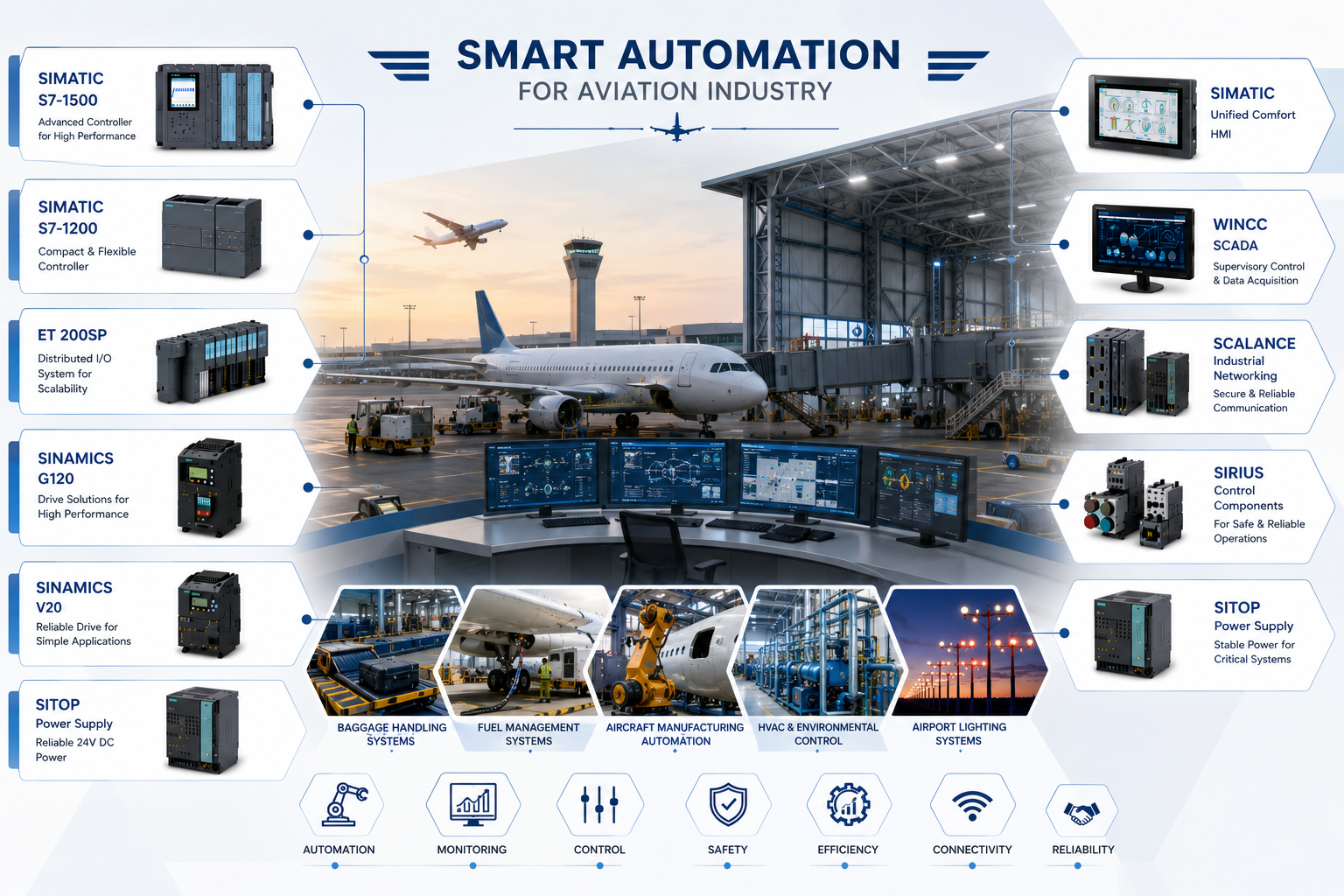
Aviation automation systems can use PLC controllers, distributed I/O, VFDs, HMI panels, SCADA software, industrial power supplies and industrial networking depending on the application. For compact ground support equipment (GSE), Siemens S7-1200-family PLCs can be considered. Larger systems such as baggage handling and multi-zone automation may require a larger controller and distributed I/O architecture.
- Ground Support Equipment (GSE)
- Aviation component and avionics test benches
- Airport baggage handling systems
- Hangar HVAC and facility automation
- Fuel-system auxiliary equipment
- Training and simulation equipment
Aviation automation involves the control, monitoring and visualization of equipment used around aircraft, airport infrastructure and aviation testing environments. Depending on the project, automation can include PLC control, variable frequency drives, HMI, SCADA, distributed I/O, industrial communication and 24 V DC power supplies.
This aviation automation guide explains how Siemens PLC, VFD, HMI and SCADA products can be considered for ground support equipment, aviation test benches, baggage handling, hangar HVAC and related auxiliary systems.
Aviation Industry Automation Applications
1. Ground Support Equipment (GSE)
Ground support equipment can include tow tractors, ground power equipment, hydraulic lifting systems, service equipment and other electrically controlled machinery. PLC-based control panels can manage sequences, motor control, sensors, interlocks and operator commands.
2. Airport Baggage Handling Systems
Baggage handling systems can contain conveyor zones, scanners, diverters, sortation equipment and distributed field devices. The automation architecture is therefore normally selected according to the total I/O count, network structure, conveyor zones, processing requirements and system layout.
3. Aviation Test Benches
Aviation component and avionics test benches can use PLC, HMI and drive systems for controlled sequences, measurements, alarms, interlocks and operator visualization. The exact controller and I/O architecture should be selected according to the required test sequence, instrumentation, response requirements and applicable safety design.
4. Hangar HVAC and Facility Automation
Large hangars and aviation facilities may require automated control of air-handling units, pumps, fans, chillers and ventilation equipment. VFDs can be used where variable-speed motor control is required for fans and pumps.
5. Fuel-System Auxiliary Equipment
Auxiliary pumps and associated equipment can use PLC, HMI, motor-control and instrumentation systems. Fuel-system projects require application-specific engineering, electrical protection and safety design according to the applicable project standards.
Typical Siemens Automation Architecture for Aviation
- Field Level: Position sensors, pressure transmitters, limit switches, motor feedback and other field signals.
- Distributed I/O: ET 200-series distributed I/O can be used where field devices are physically distributed across machinery or plant zones.
- PLC Control: S7-1200-family PLCs can be considered for compact machines and equipment, while S7-1500 can be considered for larger automation architectures.
- Drive Level: SINAMICS VFDs can control pumps, fans, conveyors and other variable-speed motor loads where required.
- HMI Level: SIMATIC HMI panels provide operator visualization, alarms, trends, status information and machine control interfaces.
- SCADA / Supervisory Level: WinCC-based systems can provide centralized visualization and monitoring for larger systems.
- Engineering: TIA Portal can be used for engineering compatible Siemens PLC, HMI and drive systems.
Siemens S7-1200 G2 PLC Siemens S7-1500 PLC Siemens ET 200SP Siemens SINAMICS G120X Siemens TP1200 HMI Siemens TIA Portal
Siemens Automation Products Used in Aviation Industry
The following table provides a practical overview of Siemens PLC, VFD, HMI, SCADA, engineering and power supply products that may be considered for aviation-related automation applications. Product selection should always be validated against the machine specification, electrical design, I/O requirements, network architecture and applicable safety requirements.
| Type | Siemens Product | MLFB / Model | Typical Aviation Application |
|---|---|---|---|
| PLC | Siemens SIMATIC S7-1200 G2 PLC | 6ES7212-1AG50 / 6ES7214-1AH50 / 6ES7215-1AG40 | Compact GSE, machine and skid control |
| PLC | Siemens SIMATIC S7-1500 PLC | 6ES7515-2AM02-0AB0 | Large automation systems and high-I/O applications |
| PLC | Siemens SIMATIC S7-300 PLC | 6ES7315-2AH14-0AB0 | Legacy systems and retrofit projects |
| Distributed I/O | Siemens ET 200SP | ET 200SP Series | Distributed field I/O and remote machine zones |
| VFD | Siemens SINAMICS G120X | SINAMICS G120X Series | Fans, pumps and HVAC-related motor applications |
| VFD | Siemens SINAMICS V20 | 6SL3210-5BE21-1CV0 | Small motors and auxiliary equipment |
| HMI | Siemens HMI TP1200 Comfort Panel | 6AV2124-0GC01-0AX0 | Test benches, machine visualization and trends |
| HMI | Siemens SIMATIC HMI Unified Panel | SIMATIC Unified Series | Modern machine and test-system visualization |
| HMI | Siemens HMI KTP1200 Basic Panel | 6AV2124-0MC01-0AX0 | Machine-level operator interface |
| SCADA | Siemens SIMATIC WinCC | WinCC Series | Supervisory monitoring and visualization |
| Engineering | Siemens TIA Portal | 6ES7822 Series | PLC, HMI and drive engineering |
| Power Supply | Siemens SITOP | 6EP1333 Series | 24 V DC control-panel power |
PLC VFD HMI SCADA
Share the Siemens MLFB/model number, required quantity, PLC or HMI family, motor/drive rating where applicable, I/O count, communication requirements, application, destination and delivery timeline. These details make a technical and commercial enquiry more precise.
Aviation Automation Product Selection Guide
There is no single PLC, VFD or HMI that fits every aviation application. Selection depends on I/O count, machine size, communication requirements, operator interface, motor load, safety architecture and future expansion requirements.
| Application | Controller | HMI | Drive / I/O | Typical Automation Requirement |
|---|---|---|---|---|
| Ground Support Equipment | S7-1200 / S7-1200 G2 | KTP / suitable SIMATIC HMI | SINAMICS V20 / local I/O | Compact machine control and interlocks |
| Aviation Test Bench | S7-1200 or S7-1500 | TP1200 / Unified | Distributed I/O / SINAMICS | Sequencing, alarms, trends and test control |
| Baggage Handling | S7-1500 | SIMATIC HMI / SCADA | ET 200SP / drives | Large I/O count and distributed conveyor zones |
| Hangar HVAC | S7-1200 / S7-1500 | SIMATIC HMI / SCADA | SINAMICS drives | Fans, pumps, ventilation and temperature control |
Compact GSE panel: S7-1200 G2 + KTP1200 + appropriate I/O and drive architecture.
Aviation test bench: S7-1500 + Unified HMI + appropriate distributed I/O and drive system.
Large baggage handling: S7-1500 + ET 200SP + appropriate HMI/SCADA + distributed drive architecture.
Why PLC, VFD, HMI and SCADA Are Used in Aviation Automation
PLC: A PLC provides programmable control for machine sequences, sensor processing, motor commands, alarms and interlocks.
VFD: Variable frequency drives can provide adjustable motor speed and controlled acceleration/deceleration for fans, pumps, conveyors and other compatible loads.
HMI: HMI panels provide operators with machine status, commands, alarms, diagnostics, trends and process information.
SCADA: SCADA can provide centralized visualization, monitoring, alarm management and historical information where the system architecture requires supervisory control.
Distributed I/O: Distributed I/O can reduce field wiring distances and provide localized I/O termination for large equipment and multi-zone installations.
Engineering Considerations for Aviation Automation
- I/O sizing: Calculate current and future digital, analog and communication requirements before selecting the controller.
- Response requirements: Validate PLC, I/O and network response against the actual machine and interlock requirements.
- Safety architecture: Emergency-stop and safety functions should use the appropriate safety-rated architecture and components where required by the application.
- Network design: Plan PROFINET and other industrial communication networks according to device count, topology, diagnostics and redundancy requirements.
- Drive sizing: Select the VFD according to motor rating, load characteristics, overload requirement and application duty.
- Environmental conditions: Consider temperature, vibration, enclosure, power quality and installation environment.
Common Aviation Automation Design Mistakes to Avoid
- Choosing a PLC only by CPU size: Controller selection should consider I/O, communication, processing, memory and expansion requirements rather than CPU size alone.
- Ignoring distributed I/O requirements: Large installations can become difficult to wire and maintain if the I/O architecture is not planned around the physical equipment layout.
- Using an unsuitable drive rating: VFD selection should consider the motor, load type, duty cycle and required acceleration or deceleration.
- Mixing HMI platforms without a standard: Standardizing screen design, runtime and engineering approach can reduce duplication across similar machines and test systems.
- Ignoring future expansion: Reserve appropriate I/O, network and panel capacity where future equipment expansion is expected.
Frequently Asked Questions About Aviation Automation
Which PLC is commonly considered for aviation ground support equipment?
For compact aviation ground support equipment, Siemens S7-1200 or S7-1200 G2 can be considered where the required I/O, communication, control logic and response requirements are within the controller's specifications.
Which HMI can be used for an aviation automation test bench?
Siemens TP1200 Comfort and SIMATIC HMI Unified Panels can be considered for test benches requiring visualization, alarms, trends, user management and sequence information.
Which PLC architecture is suitable for airport baggage handling?
Large baggage handling systems should be sized according to conveyor zones, scanners, sortation equipment, I/O count and network architecture. S7-1500 with ET 200SP distributed I/O can be considered for larger installations.
Why are PLC response time and I/O response important in aviation automation?
Aviation ground equipment and test systems can contain position, pressure, motion and emergency-stop interlocks. The controller, I/O and safety architecture should therefore be validated against the required machine response and safety requirements.
What automation products are used in aviation ground support systems?
Depending on the application, aviation GSE can use PLC controllers, distributed I/O, HMI panels, VFDs, industrial power supplies, networking components and supervisory software.
What Siemens products can be considered for aviation automation?
Siemens automation families that can be considered include SIMATIC S7 PLCs, ET 200 distributed I/O, SINAMICS drives, SIMATIC HMI panels, WinCC visualization and TIA Portal engineering software.
Aviation Automation Supply & Project Enquiry Coverage
For aviation automation product enquiries, customers can share the Siemens MLFB/model number, quantity, application, required delivery location and project timeline. This helps align product availability and quotation enquiries with the actual application.
Regional enquiry terms: India · UAE · Saudi Arabia · Qatar · Oman · Kenya · South Africa · Singapore · Malaysia · Thailand · Vietnam · Indonesia · Philippines · Sri Lanka
This regional list is an enquiry-targeting signal, not a claim of a local office or warehouse in every listed location.
Siemens Aviation Automation Products — Supply & Enquiry
Swasty Prasad Engineering supplies and supports industrial automation product enquiries for Siemens PLC, HMI, VFD, SCADA, distributed I/O and related automation products. Product requirements can be shared with the required MLFB/model number, quantity, application and delivery location for quotation and availability checking.
For aviation-related automation projects in India and international markets, customers can enquire about suitable Siemens automation products based on their project requirements.
Siemens Automation Products for Aviation Applications
PLC · VFD · HMI · SCADA · Distributed I/O · Industrial Power Supply
View Automation Products Request a Quote WhatsApp Enquiry← All Industries · Siemens Product Catalog · Automation Blog