Pharmaceutical Industry Automation Products | Siemens PLC, VFD, HMI & SCADA
Quick Answer: Which Automation Products Are Used in Pharmaceutical Manufacturing?
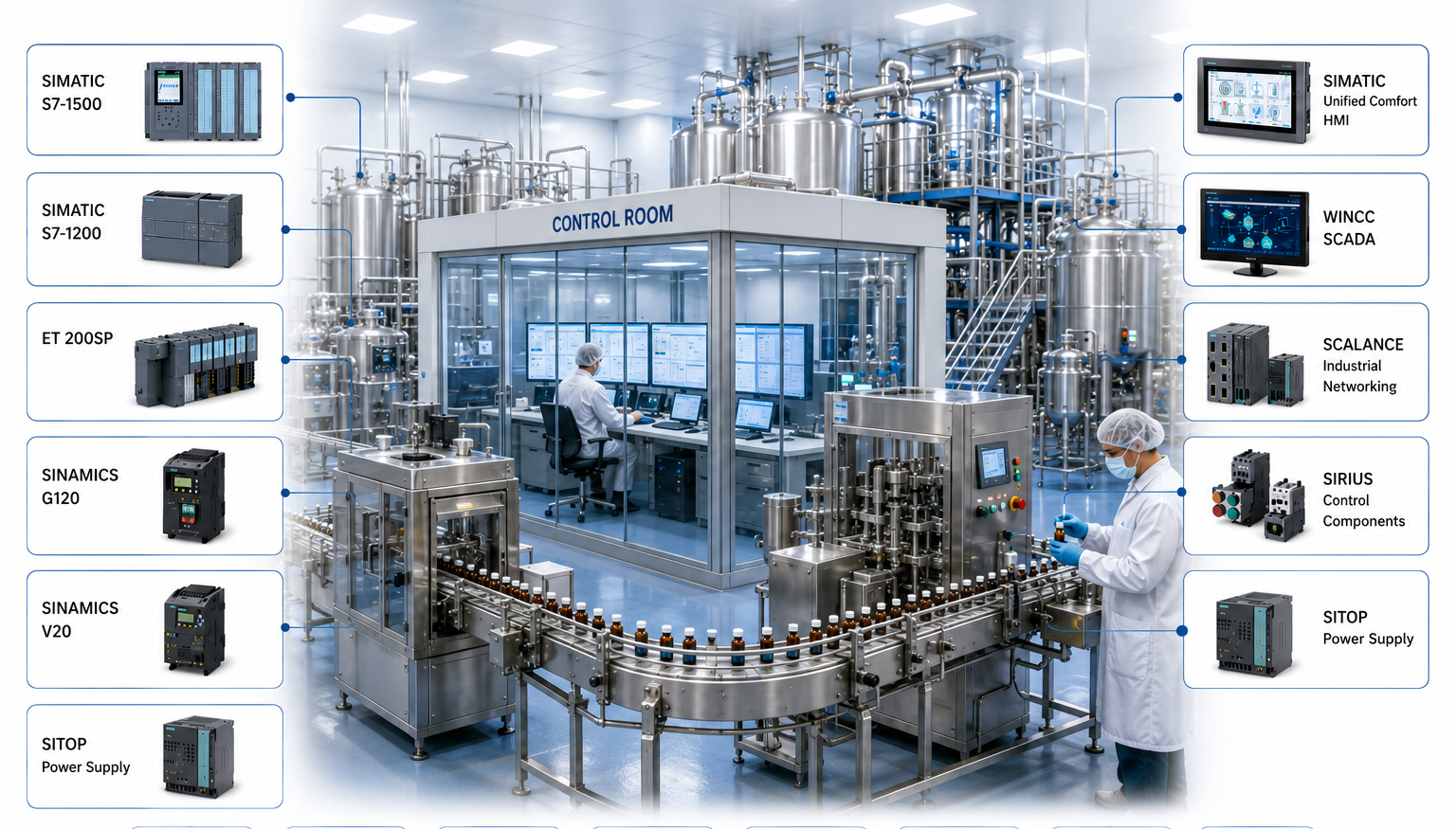
Pharmaceutical manufacturing automation commonly combines PLC controllers, VFDs, HMI panels, SCADA software, engineering software and industrial power supplies across batch processing, tablet production, coating, liquid filling, packaging, utilities and process monitoring.
Siemens automation families covered in this guide include SIMATIC S7-1200 G2, S7-1500, S7-300 for existing installations, SINAMICS V20, SINAMICS G120X, SIMATIC HMI, WinCC and TIA Portal.
The final selection should consider I/O requirements, process sequence, recipe handling, motor rating, communication architecture, HMI requirements, data logging, validation requirements and project standards.
Key Takeaways
- S7-1200 / S7-1200 G2: suitable candidates for individual pharmaceutical machines and compact automation systems depending on application requirements.
- S7-1500: can be considered for larger systems requiring higher processing, I/O or centralized automation capabilities.
- S7-300: relevant mainly when maintaining or retrofitting existing installations where the existing architecture requires it.
- SINAMICS V20: suitable for selected smaller motor applications.
- SINAMICS G120X: can be considered for suitable higher-power pump, fan and conveyor applications.
- TP1200 / Unified HMI: provide operator interaction, recipes, alarms and diagnostics depending on configuration.
- WinCC: provides supervisory visualization, alarms, trends and data management where a SCADA layer is required.
- TIA Portal: provides the engineering environment for compatible Siemens automation components.
Pharmaceutical Industry Automation: PLC, VFD, HMI & SCADA
Pharmaceutical manufacturing requires automation systems that combine process control, repeatable machine sequences, operator interaction, production data and documented system behaviour. Depending on the process, automation can be used for dispensing, mixing, granulation, tablet compression, coating, filling, capping, inspection, packaging, clean-in-place sequences and utility systems.
Unlike a simple machine-control application, pharmaceutical projects may also have requirements around user access, electronic records, audit trails, data integrity, change control and validation. These requirements are project-specific and should be defined before the automation architecture is finalized.
Pharmaceutical Manufacturing Automation Applications
1. Batch Processing and Recipe Management
PLC-based automation can control sequential process steps such as weighing, mixing, granulation and transfer. Recipe management can be used where multiple products or process variants require different operating parameters.
2. Tablet Press and Coating Automation
Tablet production equipment can use automation for machine sequences, speed control, alarms, process monitoring and operator interaction. Coating systems can also require coordinated control of drum speed, temperature, airflow and spray-related functions, depending on the equipment design.
3. Liquid Filling and Capping
Filling machines use automation for synchronized machine sequences, dosing control, conveyor movement, alarms, recipe handling and operator diagnostics. The exact control architecture depends on machine design and filling technology.
4. Blister Packaging and Cartoning
Pharmaceutical packaging machines can contain multiple synchronized stations for forming, filling, sealing, inspection, rejection and cartoning. PLCs, drives and HMIs coordinate these machine functions.
5. CIP and Utility Automation
Clean-in-place and utility systems can use automated sequences for valves, pumps, temperature, flow and other process variables. Data logging requirements depend on the plant's quality and validation architecture.
6. HVAC and Environmental Monitoring
Pharmaceutical facilities can also use automation for HVAC, pressure relationships, temperature, humidity and utility monitoring. The controller and supervisory architecture should be selected according to the facility design and applicable project requirements.
7. Packaging Line Monitoring
Machine-level PLCs and HMIs can be connected to supervisory systems where the plant requires centralized production monitoring, alarms, trends or data collection.
Typical Pharmaceutical Plant Automation Architecture
A pharmaceutical automation system can be understood through multiple control layers:
- Field level: Temperature sensors, pressure transmitters, flow meters, load cells, conductivity sensors, switches and other instruments provide process information.
- PLC control level: SIMATIC S7-1200 G2, S7-1200 or S7-1500 can execute machine sequences and process logic depending on the application.
- Drive level: SINAMICS drives can control compatible motors used in pumps, fans, conveyors and other variable-speed applications.
- HMI level: SIMATIC HMI panels can provide local machine operation, alarms, diagnostics, recipes and status information.
- SCADA level: WinCC can provide supervisory visualization, alarms, trends and data management where required by the system architecture.
- Engineering level: TIA Portal provides engineering capabilities for compatible Siemens PLC, HMI and automation components.
Siemens Automation Products Used in Pharmaceutical Industry
The following Siemens product families are listed for pharmaceutical manufacturing applications. Exact MLFB selection should be confirmed against the actual machine, hardware configuration, project specification, lifecycle status and required functionality before ordering.
| Type | Product | MLFB / Model | Typical Application |
|---|---|---|---|
| PLC | Siemens SIMATIC S7-1200 G2 PLC | 6ES7212-1AG50 / 6ES7214-1AH50 / 6ES7215-1AG40 | Compact machine control, batch sequencing and skid-level automation |
| PLC | Siemens SIMATIC S7-1500 PLC | 6ES7515-2AM02-0AB0 | Larger automation systems, higher I/O and centralized control architectures |
| PLC | Siemens SIMATIC S7-300 PLC | 6ES7315-2AH14-0AB0 | Existing installations and selected retrofit applications |
| VFD | Siemens SINAMICS V20 VFD | 6SL3210-5BE21-1CV0 | Smaller pumps, conveyors and auxiliary motor applications |
| VFD | Siemens SINAMICS G120X VFD | 6SL3200-0YC10 to 6SL3200-0YC28 | Suitable variable-speed pump, fan and conveyor applications |
| HMI | Siemens HMI TP1200 Comfort Panel | 6AV2124-0GC01-0AX0 | Recipes, alarms, trends, diagnostics and larger machine displays |
| HMI | Siemens SIMATIC HMI Unified Panel | 6AV2 Unified series | Modern multi-touch operator interfaces |
| HMI | Siemens HMI KTP1200 Basic Panel | 6AV2124-0MC01-0AX0 | Machine-level HMI applications |
| SCADA | Siemens SIMATIC WinCC V8 SCADA | 6AV6381 series | Plant visualization, alarms, trends and data management |
| SCADA | Siemens SIMATIC WinCC RT 512 | 6AV6381-2BD08-0AX0 | Smaller SCADA applications where the selected tag capacity is appropriate |
| Software | Siemens TIA Portal | 6ES7822 series | PLC, HMI and compatible automation engineering |
| Power Supply | Siemens SITOP Power Supply | 6EP1333 series | 24V DC control-panel power applications |
Pharmaceutical Automation: Compliance, Audit Trail & Validation
Pharmaceutical automation projects can have requirements for electronic records, controlled user access, audit trails, data integrity, change control and validation. However, these requirements cannot be assigned to a PLC or HMI model alone.
The complete computerized system may include the controller, HMI, SCADA, engineering software, databases, network, user-management configuration, procedures and validation documentation.
Where regulations such as 21 CFR Part 11 apply, the project team should define the applicable electronic-record and electronic-signature requirements and validate the complete system accordingly.
Therefore, avoid treating a product page or individual hardware model as a standalone “compliance certification”. The appropriate architecture should be determined with the pharmaceutical manufacturer, automation team and quality/ validation stakeholders.
How to Select Siemens Automation Products for Pharma Applications
Product selection should start with the process and validation requirements rather than selecting a PLC or HMI only by model name.
| Requirement | What to Evaluate | Automation Layer |
|---|---|---|
| Batch control | Recipes, sequences, batch parameters, I/O and process complexity | PLC |
| Motor control | Motor power, voltage, current, duty, load profile and communication | VFD |
| Operator control | Screen size, recipes, alarms, diagnostics and user access | HMI |
| Plant monitoring | Number of tags, users, alarms, trends, historical data and machines | SCADA |
| Data requirements | Electronic records, audit trails, retention and system architecture | HMI / SCADA / Database |
| Validation | URS, configuration, documentation, testing, change control and validation strategy | Complete system |
| Engineering | PLC programming, HMI configuration, supported drive integration and documentation | TIA Portal |
Machine-level pharmaceutical equipment: S7-1200 G2 or another appropriate controller + suitable SINAMICS drive + appropriate SIMATIC HMI.
Larger centralized automation: S7-1500 can be considered where the I/O, processing, communication and system architecture require it.
Plant-wide visualization: WinCC can be considered where centralized alarms, trends, visualization and data-management functions are required.
Why PLC, VFD, HMI and SCADA Are Used in Pharmaceutical Plants
PLC for Process and Machine Sequencing
PLCs execute programmed machine sequences, interlocks and process logic. In pharmaceutical applications, they can also interact with recipe and batch-management functions where supported by the complete system architecture.
VFD for Controlled Motor Operation
VFDs can control variable-speed motors used in pumps, fans, conveyors and other equipment. Correct selection depends on the motor, load and application rather than motor power alone.
HMI for Operator Interaction
HMI panels allow operators to view machine status, alarms, parameters, recipes and diagnostics. User-management functionality depends on the selected HMI and its configuration.
SCADA for Centralized Visibility
SCADA can provide centralized visualization across multiple machines or process areas, including alarms, trends and selected historical information.
TIA Portal for Engineering
TIA Portal provides an engineering environment for compatible Siemens automation components and can help maintain a common project structure across PLC and HMI engineering.
Common Pharmaceutical Automation Selection Mistakes
- Calling a hardware model “validated” by itself: Validation applies to the complete computerized system and its intended use, not simply to the PLC model.
- Choosing HMI or SCADA without defining data requirements: Check user access, alarms, audit requirements, historical data, recipe handling and system architecture before final selection.
- Ignoring change-control requirements: Changes to an existing validated automation system can require documented impact assessment, testing and revalidation according to the site's quality system.
- Selecting SCADA only by current tag count: Consider future machines, users, alarms and historical requirements when selecting the SCADA architecture.
- Ignoring lifecycle considerations: For new projects, check current product availability, support lifecycle, project standards and migration requirements.
- Mixing HMI generations without a plant standard: A consistent HMI strategy can simplify engineering, operator training and spare-parts planning.
Pharmaceutical Automation Project Checklist
Before requesting a Siemens PLC, VFD, HMI or SCADA quotation, prepare the following project information:
- Machine or process name
- Process sequence and application description
- Digital and analog I/O count
- PLC processing and memory requirements
- Number of VFDs
- Motor power, voltage and current
- Motor duty and load type
- HMI screen size and required functions
- Recipe and batch requirements
- User-management requirements
- Alarm and event requirements
- Audit-trail / electronic-record requirements, where applicable
- SCADA tag and user requirements
- Required communication protocols
- Required MLFB / exact part number
- Quantity required
- Delivery location
- Existing plant automation standard
- Validation and documentation requirements
Siemens Pharma Automation: Product-to-Application Mapping
For quick reference, the product relationships covered by this guide can be summarized as follows:
- S7-1200 / S7-1200 G2 → machine-level control, compact process equipment and selected batch or skid applications.
- S7-1500 → larger or more demanding automation architectures.
- S7-300 → existing installations and selected retrofit projects.
- SINAMICS V20 → selected smaller motor applications.
- SINAMICS G120X → suitable variable-speed pump, fan and conveyor applications.
- TP1200 / Unified HMI → operator interface, recipes, alarms and diagnostics, depending on configuration.
- WinCC → supervisory visualization, alarms, trends and data-management functions.
- TIA Portal → engineering of compatible Siemens automation components.
Frequently Asked Questions About Pharmaceutical Automation
What automation products are used in pharmaceutical manufacturing?
Pharmaceutical manufacturing automation can use PLCs, VFDs, HMI panels, SCADA software, engineering software and industrial power supplies. Siemens product families commonly considered for these applications include SIMATIC S7-1200 G2, S7-1500, S7-300 for legacy retrofit applications, SINAMICS V20, SINAMICS G120X, SIMATIC HMI, WinCC and TIA Portal.
Which Siemens PLC is suitable for pharmaceutical machine automation?
SIMATIC S7-1200 or S7-1200 G2 can be considered for individual machines depending on I/O, processing, communication and project requirements. S7-1500 can be considered for larger or more demanding automation systems where its performance, I/O capacity and architecture are appropriate.
Which Siemens PLC is used for pharmaceutical batch processing?
The PLC selection for batch processing depends on the batch architecture, I/O count, processing requirements, recipe handling, communication and validation requirements. S7-1200 G2 can be suitable for individual machine or skid-level applications, while S7-1500 can be considered for larger centralized systems.
Which Siemens VFD can be used in pharmaceutical plants?
SINAMICS V20 and SINAMICS G120X are among the Siemens drive families listed for pharmaceutical applications. The appropriate drive depends on motor power, voltage, current, load profile, duty cycle, control requirements, communication and installation conditions.
Which HMI is suitable for pharmaceutical filling machines?
TP1200 Comfort, SIMATIC Unified Panels and KTP1200 Basic are possible HMI options depending on application complexity. Selection should consider screen size, recipes, alarms, diagnostics, user management, data requirements and the project or validation architecture.
Which SCADA is used for pharmaceutical manufacturing?
SIMATIC WinCC can be used for supervisory visualization, alarms, trends and data management in suitable pharmaceutical automation architectures. The required WinCC version and licensing depend on the number of tags, machines, users, historical data and project requirements.
Does pharmaceutical automation require audit trails?
Some pharmaceutical systems require electronic records, audit trails, controlled user access and documented change history depending on the applicable regulations, quality system and intended use of the computerized system. The exact requirements should be defined during the validation and system-design process.
Does using a Siemens PLC automatically make a pharmaceutical system compliant?
No. Compliance or validation is not determined by the PLC model alone. It depends on the complete computerized system, software configuration, access control, records, procedures, documentation, validation activities and applicable regulatory requirements.
Is Siemens S7-300 still used in pharmaceutical plants?
S7-300 can still be encountered in existing pharmaceutical installations and retrofit projects. For a new project, the controller should be selected according to current product availability, project specifications, lifecycle considerations and the required automation architecture.
What is the difference between TP1200 Comfort and a Unified Panel?
TP1200 Comfort and SIMATIC Unified Panels belong to different HMI generations and provide different runtime and engineering capabilities. The appropriate choice depends on the required HMI functions, existing plant standard, engineering environment, migration strategy and project requirements.
What information is required before selecting a PLC for a pharma machine?
Important inputs include digital and analog I/O count, processing requirements, recipe and batch requirements, communication protocols, HMI requirements, expansion requirements, machine sequence complexity, environmental conditions and the project automation standard.
What information is required before selecting a VFD for a pharmaceutical machine?
Motor power, voltage, current, frequency, speed, load type, duty cycle, overload requirements, braking requirements, control method, communication requirements and installation environment should be reviewed before selecting a VFD.
Need Siemens Automation Products for Pharmaceutical Manufacturing?
PLC · VFD · HMI · SCADA · TIA Portal · Power Supply
Share the application, required MLFB, quantity and delivery location to identify the appropriate automation product.
View Siemens Automation Products Request a Quote WhatsAppExplore Automation Products by Industry
← All Industries · Siemens Product Catalog · Automation Blog