Tyre Industry Automation Products | Siemens PLC, VFD, HMI & SCADA
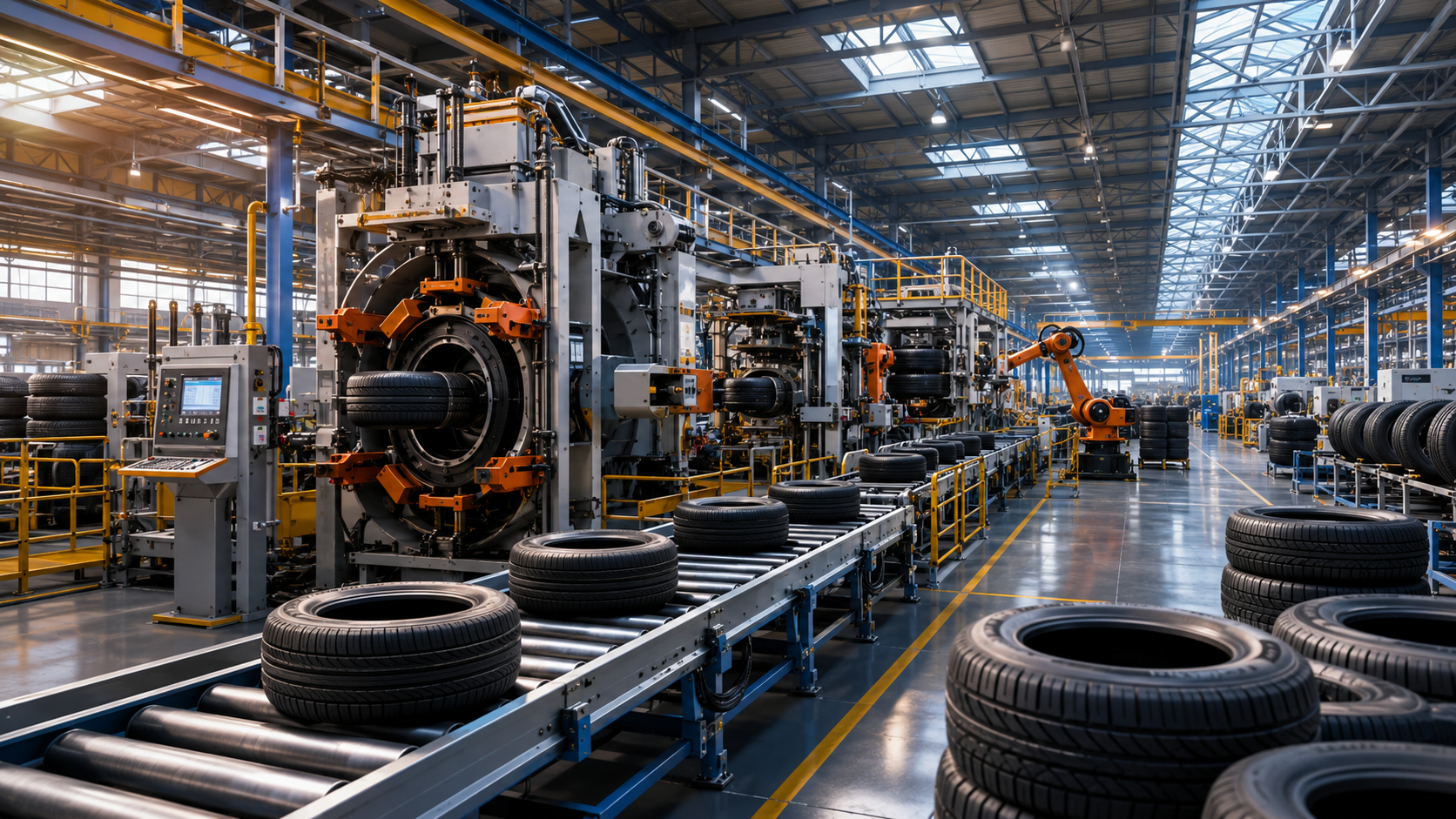
Quick Answer: Which Automation Products Are Used in Tyre Manufacturing?
Tyre manufacturing automation commonly combines PLC control, variable frequency drives, HMI panels, SCADA and engineering software across tyre building machines, curing presses, mixing and material-handling systems, conveyors and production tracking.
The Siemens product families covered on this page include SIMATIC S7-1200 G2, S7-1200, S7-1500, SINAMICS G120X, SINAMICS V20, SIMATIC HMI, WinCC and TIA Portal.
The final product selection should be based on I/O requirements, machine sequence, motor rating, communication architecture, recipe requirements, environmental conditions and project specifications.
Key Takeaways
- S7-1200 / S7-1200 G2: suitable candidates for individual machine automation depending on the machine architecture.
- S7-1500: can be considered for larger systems with higher I/O, processing or coordination requirements.
- SINAMICS G120X: used for suitable variable-speed motor applications such as conveyors and other process drives.
- SINAMICS V20: suitable for selected smaller and auxiliary motor applications when its specifications match the load.
- KTP / TP HMI: provide local operator control, diagnostics, recipes and process information.
- WinCC: provides supervisory visualization and plant-level data monitoring where the architecture requires SCADA.
- TIA Portal: provides the engineering environment for compatible Siemens automation components.
Tyre Industry Automation: PLC, VFD, HMI and SCADA
Modern tyre manufacturing involves repetitive and coordinated machine sequences across tyre building, curing, rubber processing, material handling and finished-goods movement. Automation systems are therefore designed to provide repeatable sequence control, motor-speed control, operator visualization, recipe handling, alarms and production information.
A typical tyre plant can contain multiple machine-level controllers, variable-speed drives and operator panels connected to higher-level supervisory systems. The exact architecture varies according to machine type, production capacity, plant standards and the required level of traceability.
Tyre Manufacturing Automation Applications
Different sections of a tyre plant require different automation functions. The controller, drive, HMI and SCADA architecture should therefore be selected according to the process rather than using one identical configuration for every machine.
1. Tyre Building Machine Automation
Tyre building machines use programmed sequences for operations such as drum indexing, material positioning, ply and belt handling, splicing and machine interlocks. PLC control allows these sequences and machine parameters to be managed through software.
2. Tyre Curing Press Automation
Curing presses require coordinated monitoring and control of parameters such as temperature, pressure, timing, valve sequences and machine interlocks. PLC and HMI systems provide local control and operator information.
3. Rubber Mixing and Material Handling
Mixing and material-handling sections can use variable-speed drives where motor speed needs to be coordinated with the production process. Conveyors, rollers, feeders and other auxiliary systems may use different drive ratings depending on the load.
4. Conveyor and Transfer Systems
Conveyor automation can include speed control, start/stop sequences, sensors, interlocks, product detection and transfer logic. PLCs and VFDs work together to coordinate these functions.
5. Barcode, Tracking and Reject Logic
Where required by the plant architecture, barcode or identification systems can be integrated with PLC logic and higher-level software to associate production information with machines, batches or products.
6. Recipe Management and Product Changeover
Tyre plants may manufacture multiple tyre sizes and product variants. Recipe management allows relevant machine parameters to be stored and recalled through the control system, subject to the machine's PLC and HMI capabilities.
Typical Tyre Plant Automation Architecture
A simplified tyre manufacturing automation architecture can be understood as a layered system:
- Field level: Sensors, encoders, temperature devices, pressure devices, switches and other field instruments provide process inputs.
- PLC control level: SIMATIC S7-1200, S7-1200 G2 or S7-1500 can execute machine sequences, interlocks, recipes and control logic according to the application.
- Drive level: SINAMICS G120X or SINAMICS V20 can control compatible variable-speed motor applications based on motor and load requirements.
- HMI level: KTP700, KTP1200 or TP1200 panels can provide local operator interaction, alarms, recipes and machine diagnostics.
- Supervisory level: WinCC can provide centralized visualization and production information where a SCADA layer is required.
- Engineering level: TIA Portal can be used for programming and engineering compatible Siemens automation components.
Siemens Automation Products Used in Tyre Industry
The following product families are listed for tyre manufacturing applications. The correct MLFB, hardware configuration and rating should always be confirmed against the actual machine and project requirement before ordering.
| Type | Product | MLFB / Model | Typical Tyre Industry Application |
|---|---|---|---|
| PLC | Siemens SIMATIC S7-1200 G2 PLC | 6ES7212-1AG50 / 6ES7214-1AH50 / 6ES7215-1AG40 | Machine and compact automation applications |
| PLC | Siemens SIMATIC S7-1200 PLC | 6ES7214-1AG40-0XB0 | Basic machine automation and control |
| PLC | Siemens SIMATIC S7-1500 PLC | 6ES7515-2AM02-0AB0 | Higher I/O and larger coordinated automation systems |
| VFD | Siemens SINAMICS G120X VFD | 6SL3200-0YC10 to 6SL3200-0YC28 | Suitable variable-speed applications such as conveyors and process drives; select rating according to motor/load |
| VFD | Siemens SINAMICS V20 VFD | 6SL3210-5BE21-1CV0 | Smaller motors, rollers, feeders and auxiliary drives where specifications match |
| HMI | Siemens HMI KTP1200 Basic Panel | 6AV2124-0MC01-0AX0 | Machine-level operator interface, alarms and recipes |
| HMI | Siemens HMI KTP700 Basic Panel | 6AV2123-2GB03-0AX0 | Compact machine operator interface |
| HMI | Siemens HMI TP1200 Comfort Panel | 6AV2124-0GC01-0AX0 | Larger operator screens, recipes and process information |
| SCADA | Siemens SIMATIC WinCC RT 512 SCADA | 6AV6381-2BD08-0AX0 | Supervisory visualization and selected production monitoring applications |
| Software | Siemens TIA Portal | 6ES7822 series | PLC and HMI engineering and compatible automation configuration |
| Power Supply | Siemens SITOP Power Supply | 6EP1333 series | 24V DC panel power applications |
How to Select Siemens Automation Products for a Tyre Plant
There is no single PLC, VFD or HMI configuration that fits every tyre manufacturing machine. Product selection should be based on the actual process, machine architecture and project specifications.
| Requirement | What to Evaluate | Relevant Product Layer |
|---|---|---|
| Machine control | Digital/analog I/O, processing requirement, sequence complexity, recipe/data requirements | PLC |
| Motor control | Motor power, current, voltage, speed, load profile, overload, braking and communication | VFD |
| Operator interface | Screen size, alarms, recipes, diagnostics, trends and number of operator screens | HMI |
| Plant monitoring | Number of machines, tags, alarms, production information, historical requirements and architecture | SCADA |
| Engineering | PLC programming, HMI configuration and supported drive integration | TIA Portal |
Individual machine: S7-1200 G2 or S7-1200 + suitable VFD + local HMI, depending on the machine requirements.
Larger coordinated system: S7-1500 may be considered where I/O, processing, communication or coordination requirements justify it.
Plant monitoring: WinCC can be introduced where centralized visualization, alarms, production information or data collection are required.
Why PLC, VFD, HMI and SCADA Are Important in Tyre Manufacturing
PLC for Repeatable Machine Sequences
PLC control allows tyre machines to execute programmed sequences, interlocks and process logic consistently. Recipe and data handling can also support production of multiple tyre sizes where the selected PLC architecture provides the required capability.
VFD for Variable-Speed Motor Applications
VFDs allow motor speed to be adjusted according to the process. This is useful for suitable conveyor, roller, feeder and other variable-speed applications where controlled acceleration, deceleration or speed matching is required.
HMI for Local Machine Operation
A local HMI provides operators with access to machine status, alarms, recipes, counters, parameters and diagnostics without requiring every operation to be performed from a central control room.
SCADA for Plant-Level Visibility
When several production machines need centralized monitoring, SCADA can provide a common visualization layer for alarms, production information, trends and selected historical data.
Common Tyre Plant Automation Selection Mistakes
- Under-sizing PLC memory: Multiple tyre sizes and recipe data can increase controller memory requirements. Check the actual data and program requirements before finalizing the PLC.
- Selecting a VFD only by motor kW: Motor current, duty, load characteristics, overload requirements, speed range and environmental conditions should also be considered.
- Ignoring local HMI requirements: Even when a plant has centralized SCADA, machine operators may still need local diagnostics, alarms and recipe access.
- Using one drive rating for different loads: Conveyors, rollers, feeders and process equipment can have different load characteristics. Drive selection should therefore be application-specific.
- Not defining communication requirements early: PLC, HMI, VFD and SCADA communication should be considered during the architecture stage rather than after hardware selection.
- Mixing too many HMI families: Where technically appropriate, standardizing operator panels can simplify operator training and spare-parts management.
Tyre Plant Automation Project Checklist
Before requesting a Siemens PLC, VFD, HMI or SCADA quotation, prepare the following information:
- Machine or process name
- Number of PLC digital inputs and outputs
- Analog input/output requirements
- Required PLC communication interfaces
- Number of VFDs
- Motor power, voltage, current and frequency
- Motor duty and load type
- Required HMI screen size
- Recipe and data requirements
- SCADA requirement and approximate tag count
- Required communication architecture
- Required MLFB / exact part number
- Quantity required
- Delivery location
- Project or OEM automation standard
Siemens Tyre Plant Automation: Product-to-Application Mapping
For quick reference, the product relationships on this page can be summarized as follows:
- S7-1200 / S7-1200 G2 → individual machine control and compact automation.
- S7-1500 → larger or more demanding coordinated automation systems.
- SINAMICS G120X → suitable variable-speed motor applications.
- SINAMICS V20 → selected smaller and auxiliary drive applications.
- KTP700 / KTP1200 → machine-level operator interfaces.
- TP1200 → larger HMI requirements involving more detailed operator information and navigation.
- WinCC → supervisory monitoring and SCADA requirements.
- TIA Portal → engineering of compatible Siemens automation components.
Frequently Asked Questions About Tyre Plant Automation
Which Siemens PLC is suitable for tyre conveyor lines?
S7-1200 or S7-1200 G2 can be considered for individual conveyor and machine-control applications. Larger coordinated systems may require an S7-1500 depending on I/O, processing and architecture.
Which Siemens VFD can be used for tyre plant conveyors?
SINAMICS G120X and SINAMICS V20 are included in this guide. The correct selection depends on motor rating, load, duty, control requirements and project specifications.
Which HMI is used on tyre manufacturing machines?
KTP700 Basic, KTP1200 Basic and TP1200 Comfort panels can be considered depending on screen size, operator functions, recipes, diagnostics and application requirements.
Why do tyre building machines need a PLC?
A PLC provides programmable sequence control for machine operations, interlocks, recipes and process logic. It also makes software-based changes easier when production requirements change.
Why use a VFD on tyre plant conveyors?
A VFD allows motor speed to be adjusted according to the process and can provide controlled acceleration and deceleration where the selected drive and motor are appropriate for the application.
Do tyre plants need SCADA on every machine?
No. A machine can operate with a PLC and local HMI without a plant-wide SCADA system. SCADA becomes useful when centralized visualization, alarms, production monitoring or data collection across multiple machines is required.
What should be checked before buying a Siemens PLC for a tyre machine?
Check I/O count, processing requirements, memory, communication, recipe/data requirements, expansion needs, HMI requirements, environmental conditions and the project's preferred automation architecture.
What information is required before selecting a Siemens VFD?
Motor power, voltage, current, frequency, speed, load type, duty cycle, overload requirement, braking requirement, control method and communication requirements should be evaluated.
What is TIA Portal used for in tyre plant automation?
TIA Portal is used as an engineering environment for compatible Siemens automation components, including PLC programming and HMI configuration and supported automation functions.
Can tyre plant automation be connected to a central monitoring system?
Yes, where the selected PLC, HMI, SCADA software and communication architecture support the required integration. The exact network and data architecture should be defined according to the project.
Need Siemens Automation Products for a Tyre Plant?
PLC · VFD · HMI · SCADA · TIA Portal · Power Supply
Share the required MLFB, quantity, application and delivery location to identify the appropriate product configuration.
View Siemens Automation Products Request a Quote WhatsAppExplore Automation Products by Industry
← All Industries · Siemens Product Catalog · Automation Blog