Quick Answer: Water Treatment Plant Automation
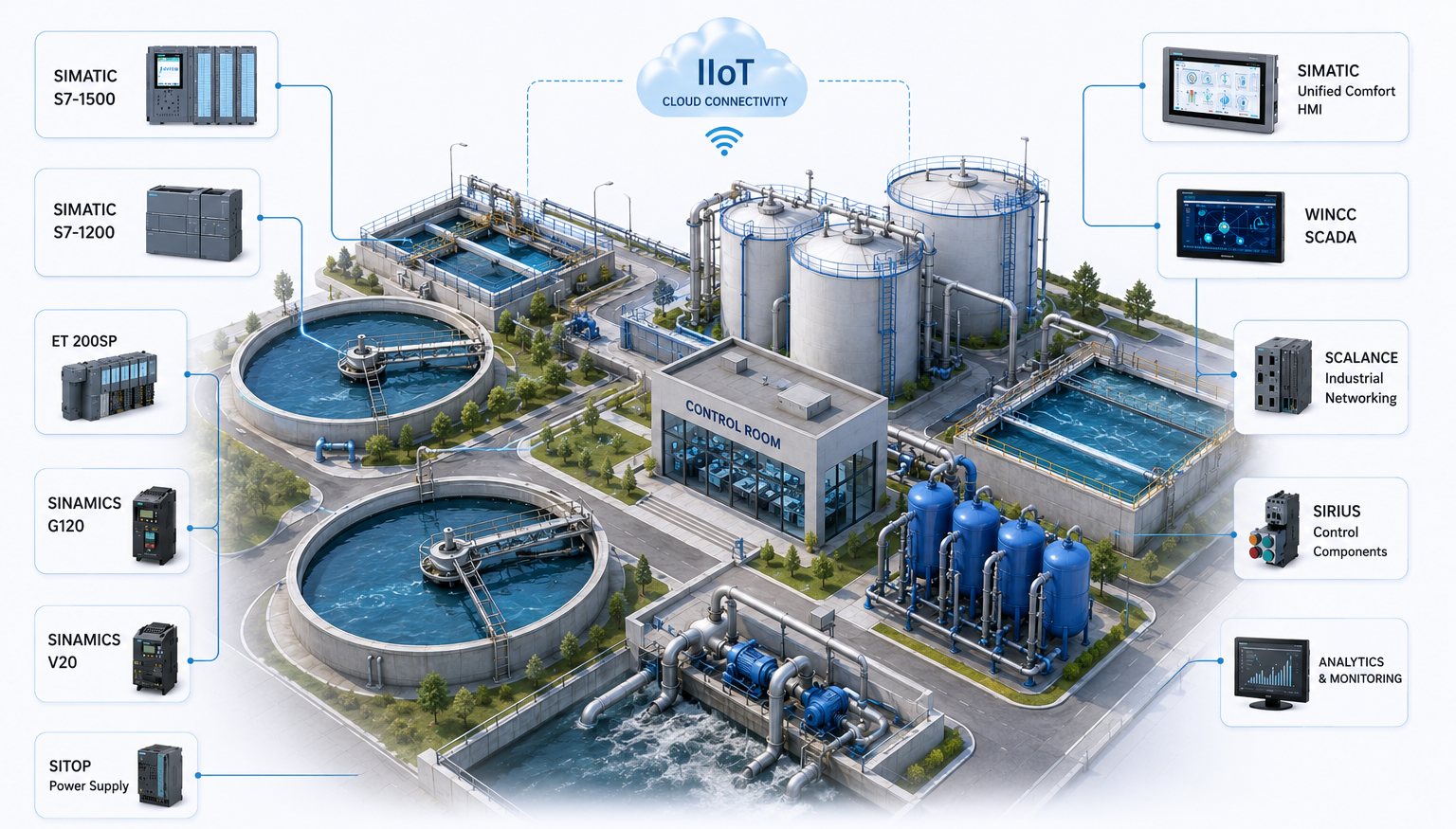
Siemens automation for water and wastewater treatment plants can include SIMATIC PLCs, SINAMICS VFDs, SIMATIC HMI panels, WinCC SCADA, ET 200SP distributed I/O, TIA Portal and SITOP power supplies.
- Compact pump station: S7-1200 G2 + SINAMICS G120X + KTP1200
- Large plant: S7-1500 + distributed I/O + WinCC
- Pump and blower control: SINAMICS G120X can be evaluated for variable-speed applications
- Operator interface: KTP1200, TP1200 or TP1500 depending on display and application requirements
- Supervisory monitoring: WinCC can provide visualization, alarms and historical process data according to the selected system configuration
Water treatment plant automation covers the control and monitoring of raw-water intake, pumping, filtration, clarification, chemical dosing, aeration, sludge handling, treated-water transfer and distribution systems.
For these applications, the automation system normally combines a PLC, VFD, HMI, distributed I/O and SCADA with field instruments such as flow, pressure, level and process-quality sensors. The exact architecture depends on plant size, number of I/O points, pump configuration, communication requirements and the project control philosophy.
This guide explains the Siemens automation products for water treatment and wastewater treatment applications, including pump stations, clarifiers, dosing systems, aeration, filtration and remote monitoring.
Water Treatment Automation Applications
The following applications are common areas where PLC, VFD, HMI and SCADA systems are evaluated in water and wastewater treatment projects:
Pump Station Automation
Duty/standby pump sequencing, run-hour balancing, level-based start/stop logic, alarms and variable-speed control.
Chemical Dosing
Flow-proportional or feedback-based control for chemical dosing systems used in treatment processes.
Clarifier & Tank Control
Continuous level monitoring and control logic for tanks, clarifiers and process vessels.
Filtration & Backwash
Automated filtration sequences, valve operation, backwash cycles and process status monitoring.
Aeration & Blower Control
Variable-speed blower control and process feedback for wastewater aeration systems.
Remote Lift Stations
Remote pump, level, alarm and equipment-status monitoring connected to a central supervisory system.
- Field instrumentation: Level transmitters, flow meters, pressure transmitters, dissolved-oxygen sensors and process-quality instruments provide plant measurements.
- PLC control: S7-1200/S7-1200 G2 or S7-1500 executes sequencing, interlocks and applicable PID control functions.
- Distributed I/O: ET 200SP can be used where field signals are distributed around pump stations, process skids or plant areas.
- Drive control: SINAMICS G120X or V20 can provide variable-speed control for selected pump, blower and auxiliary motor applications.
- Local HMI: KTP1200, TP1200 or TP1500 can provide local operation, status, alarm and diagnostic information.
- SCADA: WinCC can provide supervisory visualization, alarm handling, trends and historical process information according to system configuration.
- Engineering: TIA Portal provides an engineering environment for applicable SIMATIC PLC, HMI and drive configurations.
Siemens Automation Products Used in Water Treatment
The table below covers Siemens PLC, VFD, HMI, SCADA, engineering software and power supply products relevant to water treatment and wastewater automation projects.
Click a product to open its detailed product page, MLFB information and available commercial details.
| Type | Product | MLFB / Model | Typical Water Industry Application |
|---|---|---|---|
| PLC | Siemens SIMATIC S7-1200 G2 PLC | 6ES7212-1AG50 / 6ES7214-1AH50 / 6ES7215-1AG40 | Compact pump stations, dosing skids and machine control |
| PLC | Siemens SIMATIC S7-1200 PLC | 6ES7214-1AG40-0XB0 | Basic pump, tank and machine automation |
| PLC | Siemens SIMATIC S7-1500 PLC | 6ES7515-2AM02-0AB0 | Plant-wide control and high-I/O applications |
| VFD | Siemens SINAMICS G120X VFD | 6SL3200-0YC10 to 6SL3200-0YC28 | Water pumps, wastewater pumps, blowers and fans |
| VFD | Siemens SINAMICS V20 VFD | 6SL3210-5BE21-1CV0 | Small pumps, auxiliary motors and feeders |
| HMI | Siemens HMI KTP1200 Basic Panel | 6AV2124-0MC01-0AX0 | Local pump station and machine-level operation |
| HMI | Siemens HMI TP1200 Comfort Panel | 6AV2124-0GC01-0AX0 | Process visualization, trends and operator control |
| HMI | Siemens HMI TP1500 Comfort Panel | 6AV2124-0QC02-0AX0 | Larger process displays and control-room visualization |
| SCADA | Siemens SIMATIC WinCC RT 512 SCADA | 6AV6381-2BD08-0AX0 | Small and medium plant monitoring and alarm management |
| SCADA | Siemens SIMATIC WinCC V8 SCADA | 6AV6381 series | Plant-wide visualization, alarms and process monitoring |
| Software | Siemens TIA Portal (STEP 7 + WinCC) | 6ES7822 series | PLC, HMI and automation engineering |
| Power Supply | Siemens SITOP Power Supply | 6EP1333 series | 24V DC control-panel power supply |
PLC VFD HMI SCADA
Compact pump station / skid: S7-1200 G2 + G120X + KTP1200 can be considered for compact control architectures.
Standard treatment plant: S7-1200 or S7-1500 + distributed I/O + SINAMICS drives + local HMI + supervisory visualization.
Large or multi-area plant: S7-1500 with appropriate distributed I/O, drives, HMI and WinCC architecture can be evaluated according to the project's I/O and performance requirements.
Why Use Siemens PLC, VFD, HMI & SCADA for Water Treatment?
Siemens PLC for Pump Sequencing and PID Control
SIMATIC S7-1200 and S7-1200 G2 can be used for compact water-treatment control systems involving pump sequencing, level control, flow control, dosing logic and equipment monitoring. S7-1500 can be evaluated where the plant requires larger I/O architectures or higher system performance.
SINAMICS G120X for Water Pump Applications
SINAMICS G120X is designed for applications involving pumps and fans and can be evaluated for water and wastewater installations. Variable-speed operation allows the pump operating point to be adjusted according to process demand rather than continuously operating at one fixed speed.
HMI for Local Water Treatment Operation
A local SIMATIC HMI can give operators access to equipment status, operating commands, setpoints, alarms and diagnostics. This can be particularly useful at pump houses, dosing systems, filtration systems and remote process areas.
WinCC SCADA for Plant Monitoring
WinCC can provide centralized visualization of pumps, tanks, process values, alarms, trends and equipment status. For plants with multiple process areas or remote pump stations, the SCADA architecture can be designed around the required number of controllers, tags, users, historical data and communication links.
Water & Wastewater Treatment Process Automation
A complete automation solution can span several process stages. Product selection should follow the actual process design rather than using the same PLC or VFD configuration for every plant.
- Raw water intake: intake pumps, level monitoring and pump sequencing.
- Coagulation and dosing: chemical dosing control and flow-related process signals.
- Clarification: tank level monitoring, equipment sequencing and alarms.
- Filtration: filter status, valve sequencing and automated backwash cycles.
- Disinfection: monitoring and control of applicable dosing equipment and process instruments.
- Wastewater aeration: blower speed control and process feedback.
- Sludge handling: pump and auxiliary equipment sequencing.
- Treated-water transfer: pump control, pressure monitoring and distribution-system operating logic.
Water Treatment Automation Buyer Checklist
Before selecting a PLC, VFD, HMI or SCADA system, project teams should confirm the following technical requirements:
- Required digital and analog I/O count
- Number and rating of pumps, blowers and auxiliary motors
- Pump operating duty, control philosophy and starting requirements
- Required flow, pressure and level measurement signals
- Communication requirements such as PROFINET or other project-specified protocols
- Local HMI requirements and number of operator stations
- SCADA tag count, alarm history, trends and reporting requirements
- Environmental conditions, enclosure requirements and applicable site standards
- Required spare I/O and future expansion capacity
- Redundancy, remote monitoring and network architecture requirements where applicable
Water Treatment Automation Products — India & Global Industrial Markets
This guide is relevant to water treatment plants, wastewater treatment plants, EPC contractors, OEMs, panel builders, system integrators and industrial maintenance teams evaluating Siemens automation products.
Product sourcing requirements can vary by project location, plant standards, motor specifications, control architecture and applicable regulations. For export-oriented projects, the required MLFB, quantity, voltage, communication and delivery requirements should be confirmed before quotation.
Common industrial markets associated with water and wastewater automation sourcing include India and industrial markets across the Middle East, Africa and Asia.
Common Water Treatment Automation Selection Mistakes
- Selecting only by motor kW: VFD selection should also consider motor data, application, overload requirements, operating conditions and project specifications.
- Ignoring I/O expansion: Future instruments, additional pumps and process expansion can increase the required I/O capacity.
- Using fixed-speed control for every pump: Some processes benefit from variable-speed operation, while others may not. The control philosophy should be established from the hydraulic and process requirements.
- Ignoring remote station requirements: Lift stations and remote assets may require additional communication, networking and supervisory architecture.
- Choosing SCADA only by tag count: The complete requirement can include users, alarms, trends, historical data, redundancy and integration requirements.
- Ignoring site/environment requirements: Panel construction, ambient conditions, ingress protection, electrical standards and applicable site classifications should be reviewed before final equipment selection.
Product selection should be verified against the current Siemens technical documentation, project specifications, motor data, pump duty, I/O list, environmental conditions, communication architecture and applicable site standards. Product availability, MLFB status and commercial pricing can change, so the exact part number should be confirmed before purchase or project release.
Related Siemens Automation Product Categories
- Siemens S7-1200 G2 PLC — compact PLC automation for pump stations and process skids.
- Siemens SINAMICS G120X — variable-speed drive applications for pumps and fans.
- Siemens TP1200 HMI — process visualization and local operator control.
- Siemens WinCC RT 512 — SCADA visualization for suitable smaller-scale systems.
- Siemens TIA Portal — engineering platform for applicable PLC, HMI and automation configuration.
Frequently Asked Questions About Water Treatment Automation
Which PLC is suitable for a water treatment pump station?
Siemens SIMATIC S7-1200 or S7-1200 G2 can be considered for compact pump stations, sequencing, monitoring and PID-based level or flow control. Larger plant-wide systems may use S7-1500 depending on I/O, performance and architecture requirements.
Which Siemens VFD is used for water treatment pumps?
SINAMICS G120X is commonly evaluated for water and wastewater pump and fan applications. The drive can integrate with Siemens PLC systems over PROFINET for speed reference, status and diagnostic data.
Which SCADA is suitable for a water treatment plant?
WinCC RT 512 can be considered for smaller monitoring applications, while WinCC V8 can be considered for larger plant-wide visualization, alarm management, trending and multi-system monitoring requirements.
Why use a VFD instead of a fixed-speed starter for water pumps?
A VFD allows controlled acceleration and deceleration and lets pump speed be adjusted according to process demand. This can help reduce starting stress, pressure transients and energy consumption compared with operating a pump continuously at fixed speed.
Can a small water treatment plant operate without SCADA?
Yes. A smaller installation can use a PLC with a local HMI for basic operation and monitoring. SCADA can be added when the plant requires centralized visualization, historical trends, alarm history, reporting or monitoring of multiple remote assets.
What communication protocol can connect a Siemens VFD to a PLC?
PROFINET is commonly used to connect SINAMICS drives with SIMATIC S7-1200 and S7-1500 PLCs. It can provide drive commands, speed references, operating status, diagnostics and fault information through the industrial network.
What automation products are commonly used in wastewater treatment plants?
Typical automation architecture can include Siemens SIMATIC PLCs, SINAMICS VFDs, ET 200SP distributed I/O, SIMATIC HMI panels, WinCC SCADA, TIA Portal engineering software and SITOP 24V DC power supplies.
What should be checked before selecting a PLC and VFD for a water treatment project?
The selection should consider motor rating and duty, pump operating conditions, required I/O count, analog signal types, communication requirements, environmental conditions, control philosophy, redundancy requirements and applicable project or site standards.
Siemens Automation Products for Water Treatment
PLC · VFD · HMI · SCADA · Distributed I/O · Automation Software
Discuss your required Siemens MLFB, quantity, application and project requirements.
View All Products Get Quote WhatsApp