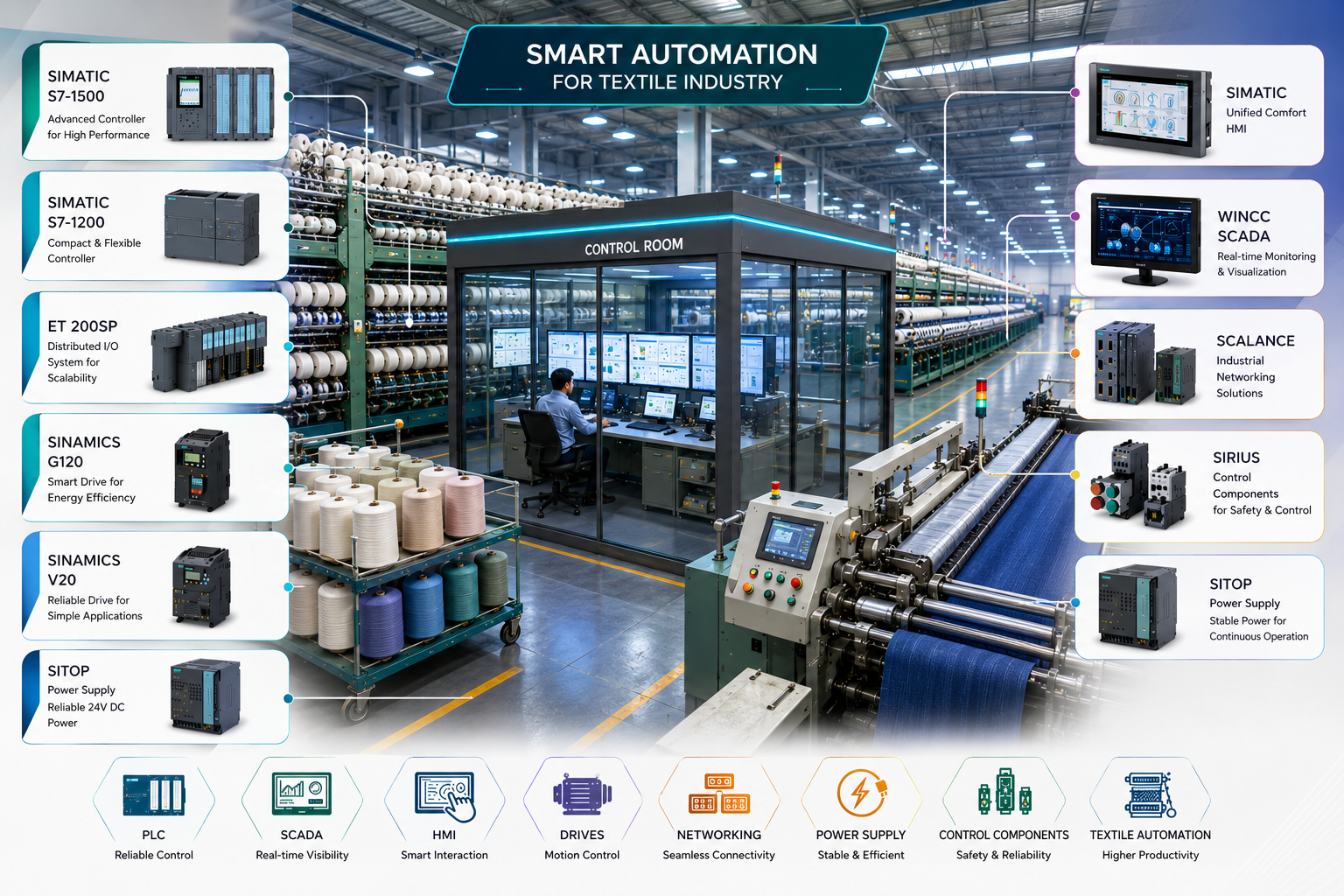
Textile mills can use Siemens PLC, VFD, HMI, SCADA and 24V DC power supply solutions for loom automation, winding, speed synchronization, tension control, dyeing processes, conveyors, finishing lines and production monitoring. A typical machine-level architecture can combine S7-1200 G2 or S7-1200 PLC, SINAMICS drives and KTP-series HMI, while WinCC can provide supervisory monitoring where required.
Textile manufacturing involves continuous and coordinated motion across spinning, weaving, winding, dyeing and finishing processes. Looms, winders, conveyors and processing equipment may require accurate speed feedback, encoder measurement, tension control and operator monitoring.
This guide covers commonly considered Siemens automation products for textile industry applications, including PLC controllers, SINAMICS variable frequency drives, HMI panels, SCADA software, TIA Portal engineering and SITOP power supplies.
The selection of an automation product depends on the machine architecture, I/O requirements, motor characteristics, control strategy, communication requirements and existing installed equipment.
Swasty Prasad Engineering provides industrial automation product sourcing and support for textile manufacturing applications in India and international project requirements, subject to product availability, technical specifications and project scope.
Textile Industry Automation Applications
Textile automation can be applied across machine-level and process-level operations. Common application areas include:
- Loom speed and stop-motion control — synchronizing machine motion with warp let-off and monitoring suitable stop-motion signals.
- Winder tension and length measurement — encoder-based measurement and drive control for winding applications.
- Dyeing line temperature control — PLC-based process sequencing and PID-based temperature control where required by the machine.
- Finishing conveyor systems — coordinated motor and conveyor operation through stenter, calendering and coating stages.
- Warp beam handling — motor control and feedback-based operation to maintain the required process conditions as the beam changes.
Which Siemens PLC is Suitable for Textile Machine Automation?
S7-1200 G2 or S7-1200 can be considered for compact textile machines where PLC control, encoder feedback, machine sequencing and suitable high-speed counter functions are required. Smaller standalone machines can also use S7-200 SMART, depending on I/O and application requirements.
Which Siemens VFD is Used in Textile Applications?
SINAMICS G120X can be selected for appropriate motor-control applications, while SINAMICS V20 is suitable for various smaller motor and auxiliary applications. Existing textile machinery may also contain legacy MM420 drives that require compatible replacement or maintenance.
Which HMI is Used for Textile Machines?
KTP700 Basic and KTP1200 Basic panels can be used for machine-level operator interaction, including speed values, production counters, operating status and fault information.
- Field level: rotary encoders, tension measurement devices, sensors and machine signals provide feedback to the controller.
- Control level: SIMATIC S7-1200 G2 or S7-1200 PLCs can manage machine sequencing, suitable high-speed counter functions, length measurement and control logic. Smaller standalone machines may use S7-200 SMART .
- Drive level: SINAMICS G120X can be used for suitable main motor applications, while SINAMICS V20 can handle various auxiliary motor requirements. Existing machines may continue using MM420 drives.
- Local HMI: KTP700 or KTP1200 Basic panels provide local operator information and machine controls.
- Supervisory level: WinCC can collect production, status and downtime information from multiple machines where the system architecture supports it.
- Engineering layer: TIA Portal can be used for engineering applicable Siemens PLC, HMI and drive components within supported project configurations.
Siemens Automation Products Used in Textile Industry
The following list covers the main Siemens automation product categories included in this textile industry guide. Product selection should always be checked against the exact machine specification, electrical design, I/O count, motor rating and required functionality.
| Type | Product | MLFB / Model | Typical Textile Application |
|---|---|---|---|
| PLC | Siemens SIMATIC S7-1200 G2 PLC | 6ES7212-1AG50 / 6ES7214-1AH50 / 6ES7215-1AG40 | Compact machine and process control |
| PLC | Siemens SIMATIC S7-1200 PLC | 6ES7214-1AG40-0XB0 | Basic machine automation |
| PLC | Siemens SIMATIC S7-200 SMART PLC | 6ES7288-1SR20-0AA0 | Small standalone machines |
| VFD | Siemens SINAMICS G120X VFD | 6SL3200-0YC10 to 6SL3200-0YC28 | Suitable motor, pump, fan and conveyor applications |
| VFD | Siemens SINAMICS V20 VFD | 6SL3210-5BE21-1CV0 | Small motors and auxiliary drives |
| VFD | Siemens SINAMICS MM420 VFD | 6SE9211-0DA40-1AA0 | Legacy motor speed control |
| HMI | Siemens HMI KTP700 Basic Panel | 6AV2123-2GB03-0AX0 | Compact operator panels |
| HMI | Siemens HMI KTP1200 Basic Panel | 6AV2124-0MC01-0AX0 | Machine-level HMI |
| SCADA | Siemens SIMATIC WinCC RT 512 SCADA | 6AV6381-2BD08-0AX0 | Suitable small-system SCADA applications |
| Software | Siemens TIA Portal | 6ES7822 series | PLC, HMI and drive engineering |
| Power Supply | Siemens SITOP Power Supply | 6EP1333 series | 24V DC panel power |
Per machine: loom, winder or suitable process skid can be configured around S7-1200 G2 , an appropriate SINAMICS drive and KTP700 or KTP1200 , depending on the application requirements.
Mill-wide monitoring: where multiple machines need centralized production or downtime monitoring, a suitable WinCC SCADA architecture can be added above the machine-level PLC systems.
Why Siemens PLC, VFD, HMI & SCADA Are Used in Textile Automation
Textile machinery frequently involves coordinated motion and process sequencing. PLCs can execute machine logic and interface with field signals, while appropriate drive systems provide motor speed and control functions according to the application's requirements.
For loom and winder applications, encoder feedback can be important for speed and length-related functions. Where high-speed pulse processing is required, the PLC should use an appropriate high-speed counter or technology supported by the selected controller and encoder.
On the drive side, SINAMICS G120X and V20 can serve different motor-control requirements, while existing textile equipment may retain older drive families such as MM420. Modernization should be based on compatibility, motor data, control requirements, panel changes and spare-part strategy.
KTP-series HMI panels provide a local operator interface for machine information, alarms and process values. For larger production environments, a suitable WinCC-based supervisory layer can bring together information from multiple machines.
TIA Portal can provide an engineering environment for supported Siemens PLC, HMI and drive components. This can simplify engineering where multiple machines use a similar automation architecture.
Common Textile Automation Mistakes to Avoid
- Using unsuitable digital inputs for encoder feedback: verify the required pulse frequency and use an appropriate high-speed counting solution.
- Undersizing drive control: verify motor rating, load characteristics, required control mode, acceleration/deceleration and process response before selecting a VFD.
- Ignoring HMI panel dimensions: confirm the actual panel cutout and mounting requirements before selecting KTP700, KTP1200 or another HMI size.
- Mixing multiple drive families without a spares plan: maintain a documented spare-parts list for installed G120X, V20, MM420 or other drive families.
- Choosing products only by product name: verify the exact MLFB, voltage, current, motor rating, communication interface, I/O requirements and environmental conditions before ordering.
Frequently Asked Questions About Textile Automation
Which PLC is used for textile looms?
Siemens S7-1200 G2 or S7-1200 PLCs can be considered where encoder feedback, high-speed counting, machine sequencing and stop-motion logic are required. Smaller standalone machines may use S7-200 SMART depending on the application.
Which VFD is used for textile winder motors?
SINAMICS G120X can be selected for suitable main drive applications, while SINAMICS V20 can be used for various smaller motor and auxiliary applications. Existing machinery may also use MM420 drives.
Which HMI is suitable for textile machines?
KTP700 Basic and KTP1200 Basic panels can provide machine-level operator functions such as speed display, production counters, status information and fault alarms.
Why does a textile loom PLC need high-speed counters?
Loom and winder automation can require accurate encoder pulse counting for length measurement, speed feedback and stop-motion functions. High-speed counter inputs are designed to process suitable high-frequency pulse signals more effectively than ordinary digital inputs.
Why are MM420 drives still found in textile plants?
Existing textile machines may continue using MM420 drives where the installed equipment remains operational. Replacement decisions depend on equipment condition, compatibility, availability and modernization requirements.
Can one PLC control multiple textile looms?
The architecture depends on the machine design. Individual looms may use dedicated PLC control, while a supervisory SCADA system such as WinCC can aggregate production and downtime information from multiple machines.
Siemens Automation Products for Textile Industry
PLC · VFD · HMI · SCADA · Power Supply
Contact Swasty Prasad Engineering for textile automation product requirements, specifications and quotations.
View Automation Products Get Quote WhatsAppExplore Automation Solutions for Other Industries
← All Industries · Siemens Automation Product Catalog · Industrial Automation Blog